
What Is Attribution? Models, Windows, and the Vendor Underneath
What Is Attribution? Models, Windows, and the Vendor Underneath
You trust RevenueCat, Adapty or Superwall to tell you how much money came in this month. You have nothing you trust the same way to tell you where it came from.
Attribution is that missing layer: the record of which ad, which keyword, which campaign actually produced the subscriber. Most founders discover it exists the moment two dashboards show two different numbers for the same week, and there is no obvious reason to believe either one.
That is not a reporting inconvenience. It is a piece of infrastructure you do not have yet. By the end of this you will know what attribution actually is, why it broke in 2021, what every vendor selling the fix is really selling underneath the branding, and what the whole layer costs.
Attribution Is a Record or an Estimate
Attribution is the process of matching an install or a subscription back to the ad that caused it. On the web it is easy, because the click and the purchase happen in the same browser, so one identity carries the whole way through. In apps it is hard: the click happens inside an ad, the install happens inside the App Store, and something has to carry an identity across the gap between them.
There are only two ways to do that, and the difference is the whole subject.
Deterministic attribution is a record. A verifiable match, where a real identifier links the click to the install. Android's Play Install Referrer works this way and runs around 98% accuracy.
Probabilistic attribution is an estimate. A modeled guess built from signals like IP address, device type and timestamp. On iOS without user consent this is what you get, and it runs 70% to 90% in good conditions, degrading fast under VPNs, iCloud Private Relay and shared wifi.
Apple's own rulebook prohibits that estimate. The industry runs on it anyway, and almost no vendor page tells you which one you are buying.
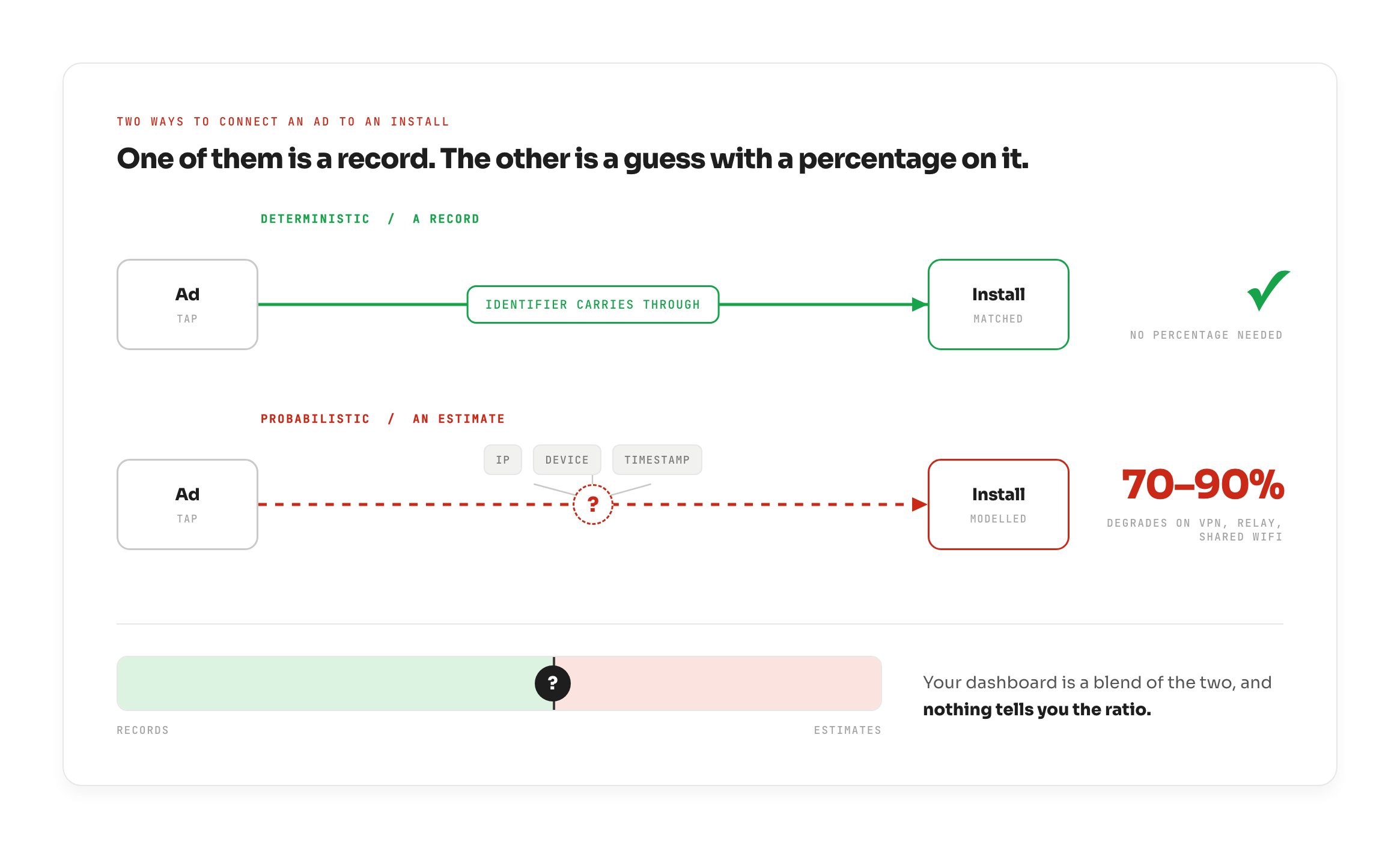
In practice you get both at once. Any single match is either a record or an estimate, but a measurement tool uses the record where one exists and falls back to the estimate where it does not. What you read on the dashboard is a blend, and nothing tells you the ratio.
What Apple Actually Allows: ATT and the SKAdNetwork Box
iOS did not start out as an estimate. Until 2021, the IDFA carried a user cleanly from ad to install, and attribution on iPhone was a record like any other.
App Tracking Transparency closed that identity. The IDFA now requires an opt-in prompt most people decline. In its place, Apple offered SKAdNetwork: a box whose walls are precisely measurable.
Here is the box. The first SKAN report arrives after a delay of 24 to 48 hours, the second and third after delays of 24 to 144 hours. The three reports cover activity windows of days 0-2, 3-7 and 8-35. Everything a user does inside your app has to be compressed into a single number between 0 and 63, which is 64 possible states, and only the first report carries it. Below Apple's privacy crowd threshold even that number is withheld, in four tiers, down to a tier where the second and third reports are never sent at all.
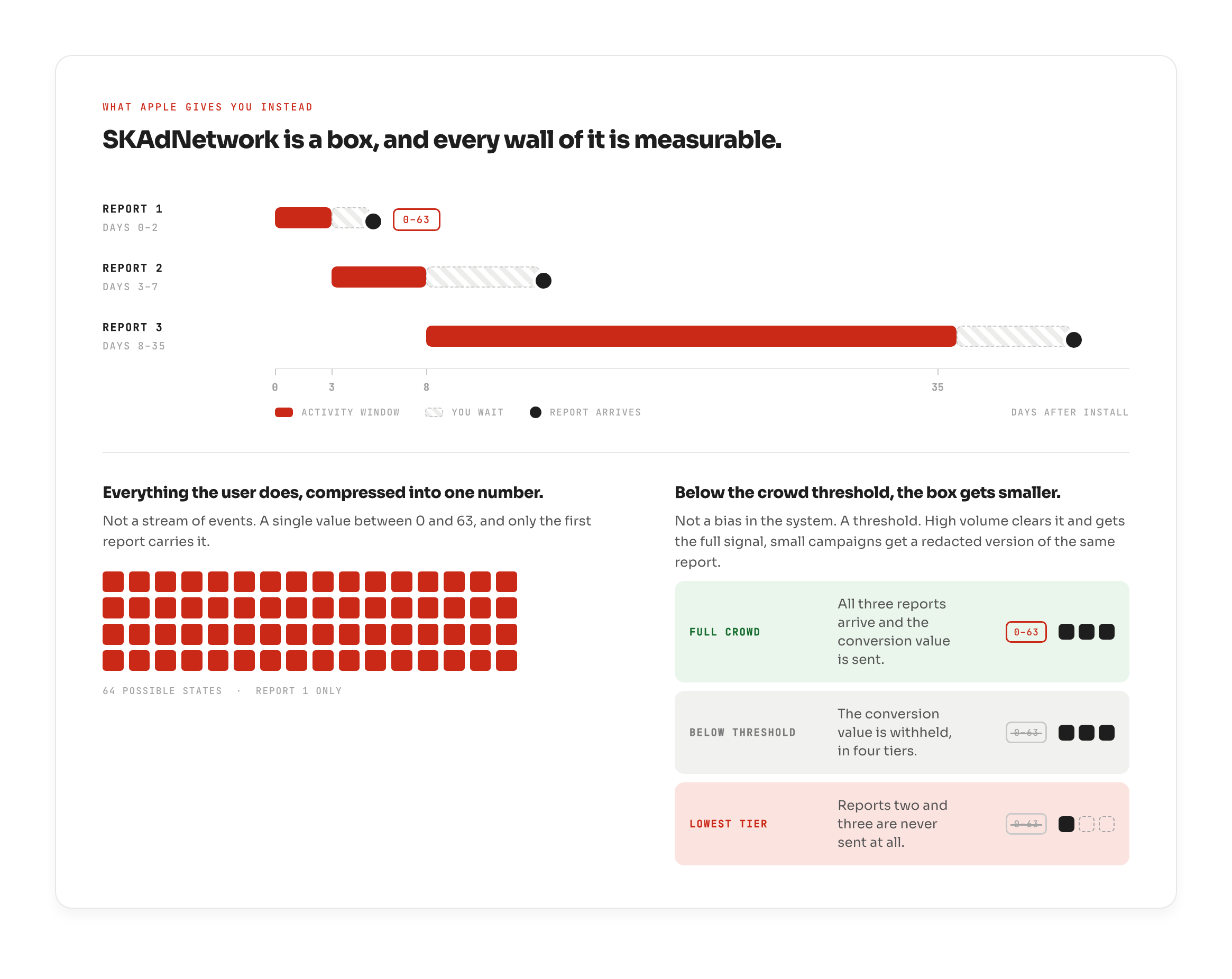
That last detail is the concrete mechanism behind the vague complaint that measurement is "easier for big advertisers." It is not a bias in the system. It is a threshold. High-volume campaigns clear the crowd minimum and get the full signal; small ones receive a redacted version of the same report.
Consent itself is not the flat line people assume. Opt-in ran at 38% globally in Q1 2026, up from 35% a year earlier, though other methodologies put it closer to 27%. Both figures are correct. They differ because they count different denominators, and it is worth knowing which one a vendor is quoting at you.
SKAdNetwork is widely expected to be succeeded by newer frameworks, but Apple has announced no sunset date, so it remains the floor everyone builds on.
Why No Two Dashboards Agree
Apple's box is only one of the sources feeding your reports. The ad networks are another, and they do not agree with Apple or with each other.
Every self-attributing network, meaning Meta, Google and TikTok, counts conversions through its own attribution window and grants itself the credit. Run one subscriber past two networks and both can legitimately claim them. The same person gets counted twice, in two places, and neither dashboard is lying.
The size of the disagreement is measurable. Benchmarking platform-reported conversions against MMP-reported conversions in 2025, Cassandra found Meta over-reporting by a median of 134%, and Google by roughly 18%.
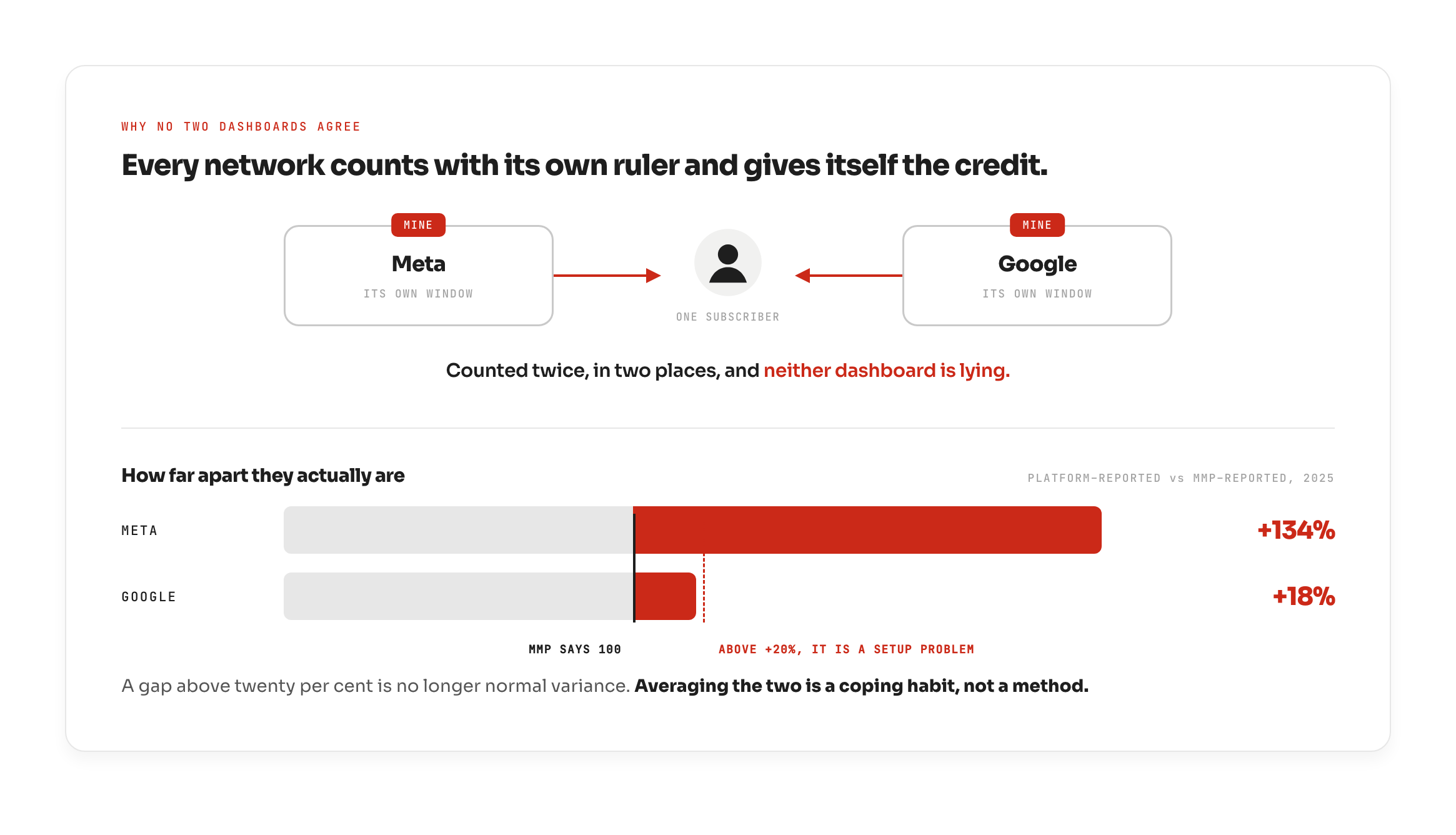
That gives you a rule you can actually use: a gap above 20% between two sources is no longer normal variance, it is a setup problem worth investigating.
The common advice to just average the two platforms is a coping habit, not a method. Averaging two wrong numbers gives you a third wrong number with a false sense of calm attached.
The Vendor Underneath: What They Actually Sell
Refereeing that disagreement is a real job, and there is an industry built to do it.
If you go looking for a fix, you will meet six names quickly: AppsFlyer, Adjust, Singular, Airbridge, Tenjin and Kochava. These are the ones an app team realistically encounters first, in a sales call, a job post, or a competitor's stack. They belong to a category called Mobile Measurement Partners, and before comparing them it helps to know that the category sells the same three things.
An MMP does three jobs. It consolidates every channel into one panel. It referees the conflicting claims those channels make. And it models the part that cannot be measured directly.
That is the honest description. What an MMP does not do is restore the identity Apple took away. It cannot turn an estimate back into a record. It organizes and referees the uncertainty; it does not remove it. Any vendor implying otherwise is selling the branding, not the mechanism.
Which is why the marketing language across the category is a distraction. The one selling "automation," the one selling "analytics" and the one selling "deep linking" all perform those same three functions underneath.
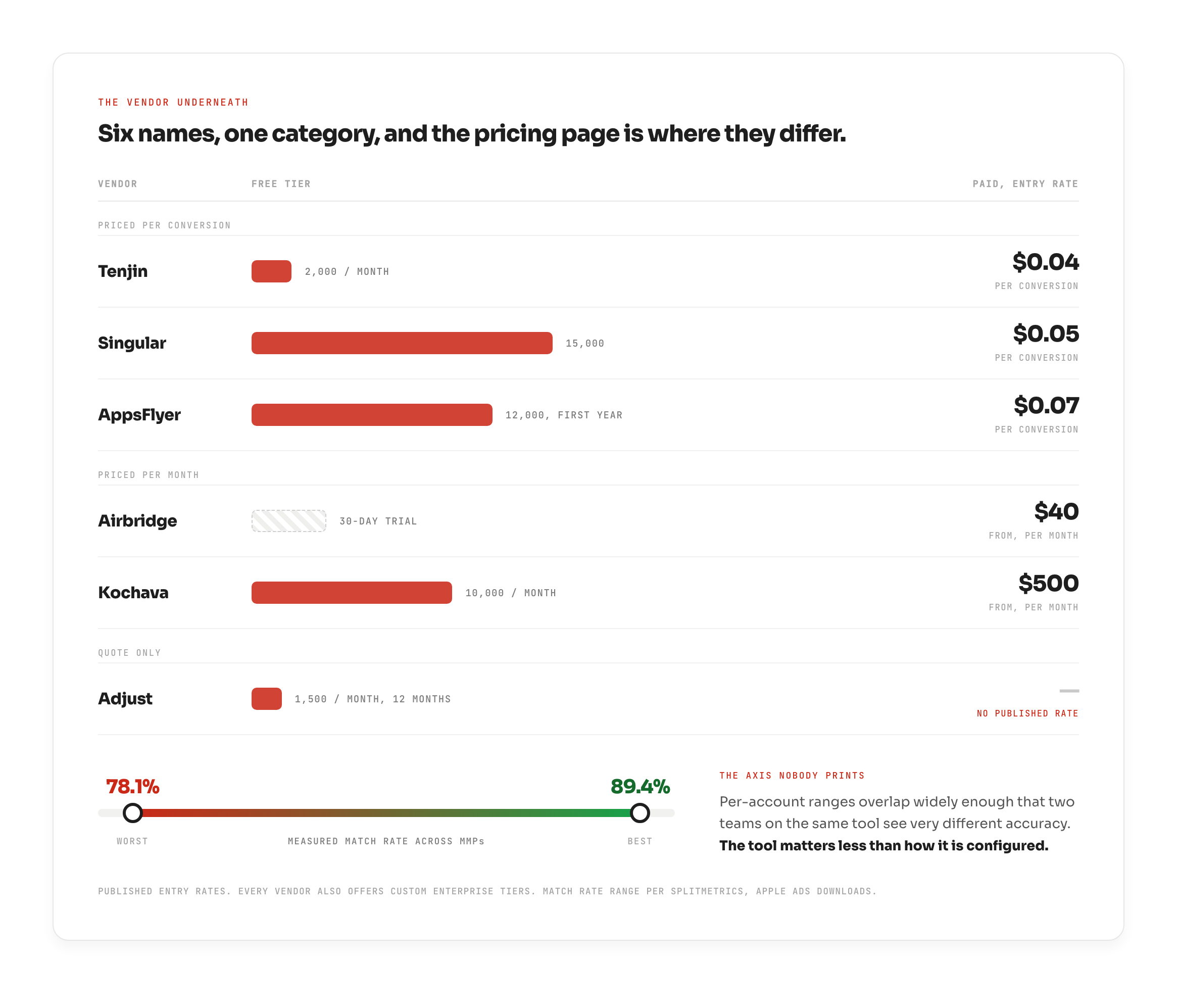
Published entry rates. Every vendor above also offers custom enterprise tiers, and Adjust publishes no paid rate at all, which is worth noting when you are the one doing the comparing.
What genuinely separates these tools is not technology. It is the price model, which ad networks they integrate cleanly with, and their match rate.
On that last one there is real measured data. Tracking how reliably each MMP connects an Apple Ads download to an install, SplitMetrics found a spread running from 89.4% down to 78.1%, with per-account ranges wide enough to be a finding on their own. Two teams on the same tool can see very different accuracy depending on their channel mix and their settings, which is the same lesson from another angle: the tool matters less than how it is configured. That is the real axis of comparison, and it is the one the pricing pages bury.
Around the MMPs sit the neighbours. Apple runs its own attribution for its own ad channel, and because Apple owns both the ad and the store there is no gap to guess across, so it comes back genuinely deterministic, down to the keyword. That deserves its own treatment and gets one in the next piece in this series. Google has ODM and ICM, Meta has AEM, and then there is the subscription layer, where RevenueCat, Adapty and Superwall sell ASA attribution as a side effect of already sitting inside your app.
What Measurement Actually Costs
None of this is free, and the price is harder to find than it should be. So here it is.
At 50,000 monthly installs, measurement runs roughly $30,000 to $42,000 a year. At 100,000 it reaches around $84,000. As a rule of thumb that is 5% to 10% of a total marketing budget.
Then there is the invisible line item, which is the 4 to 8 hours a week someone spends manually reconciling panels that do not agree. That reconciliation tax is why, in Adjust's Mobile App Trends 2026 report, only around 31% of marketers said they were completely satisfied with their ability to unify and read data across platforms.
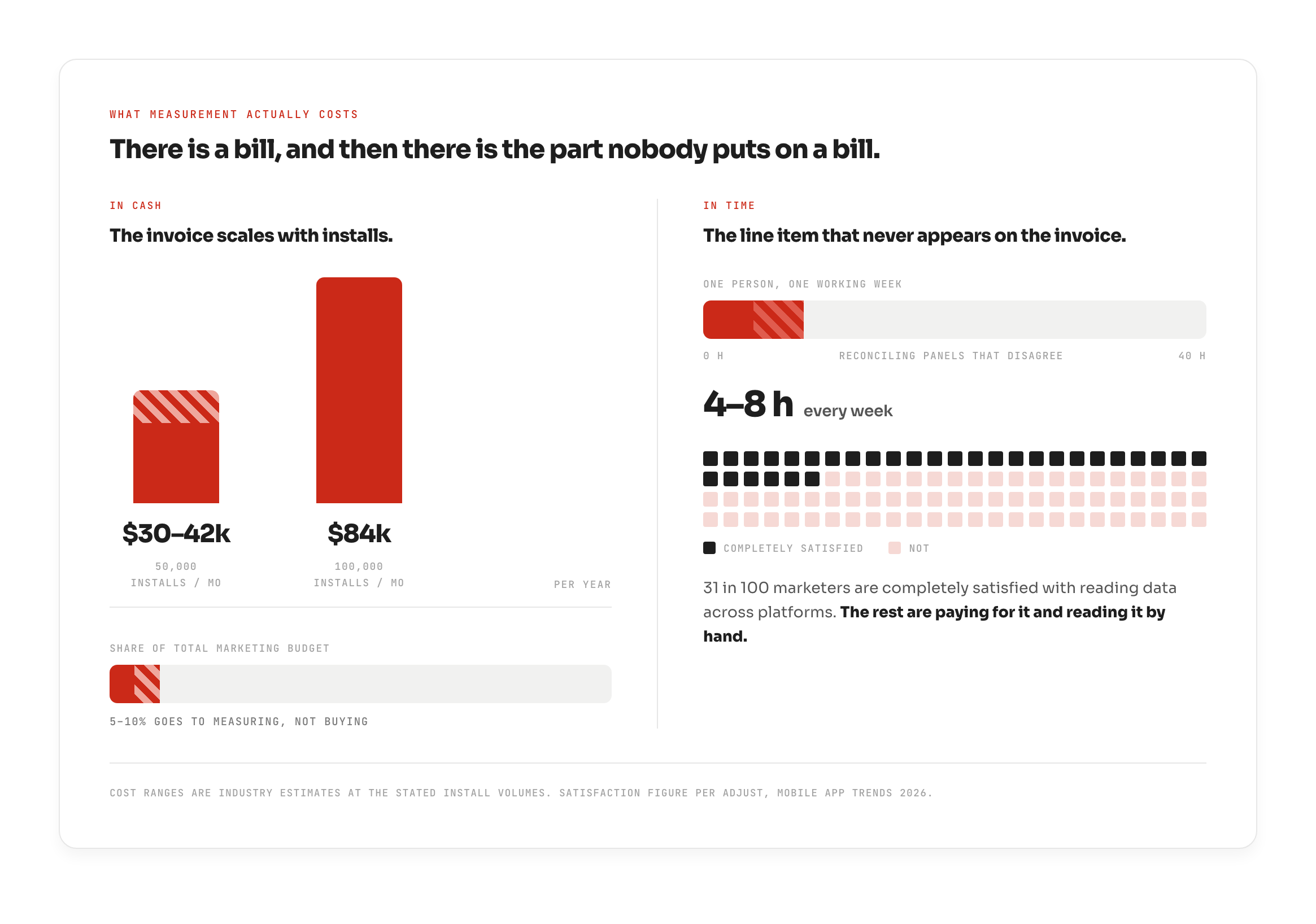
Read that number carefully, because it points somewhere specific. The tools are not failing to produce data. Nearly seven in ten teams are paying for the data and still doing the reading by hand.
Where OWA AI Sits
That is the gap OWA AI is built for.
OWA is not a replacement for the measurement layer. It is the brain that sits on top of it. The measurement stack, meaning your MMP, your subscription analytics and your ad-network reporting, produces the numbers. What is missing is a single operator reading across all of them at once.
The data already exists. It just stays disconnected across five panels that each see one slice of the same user.
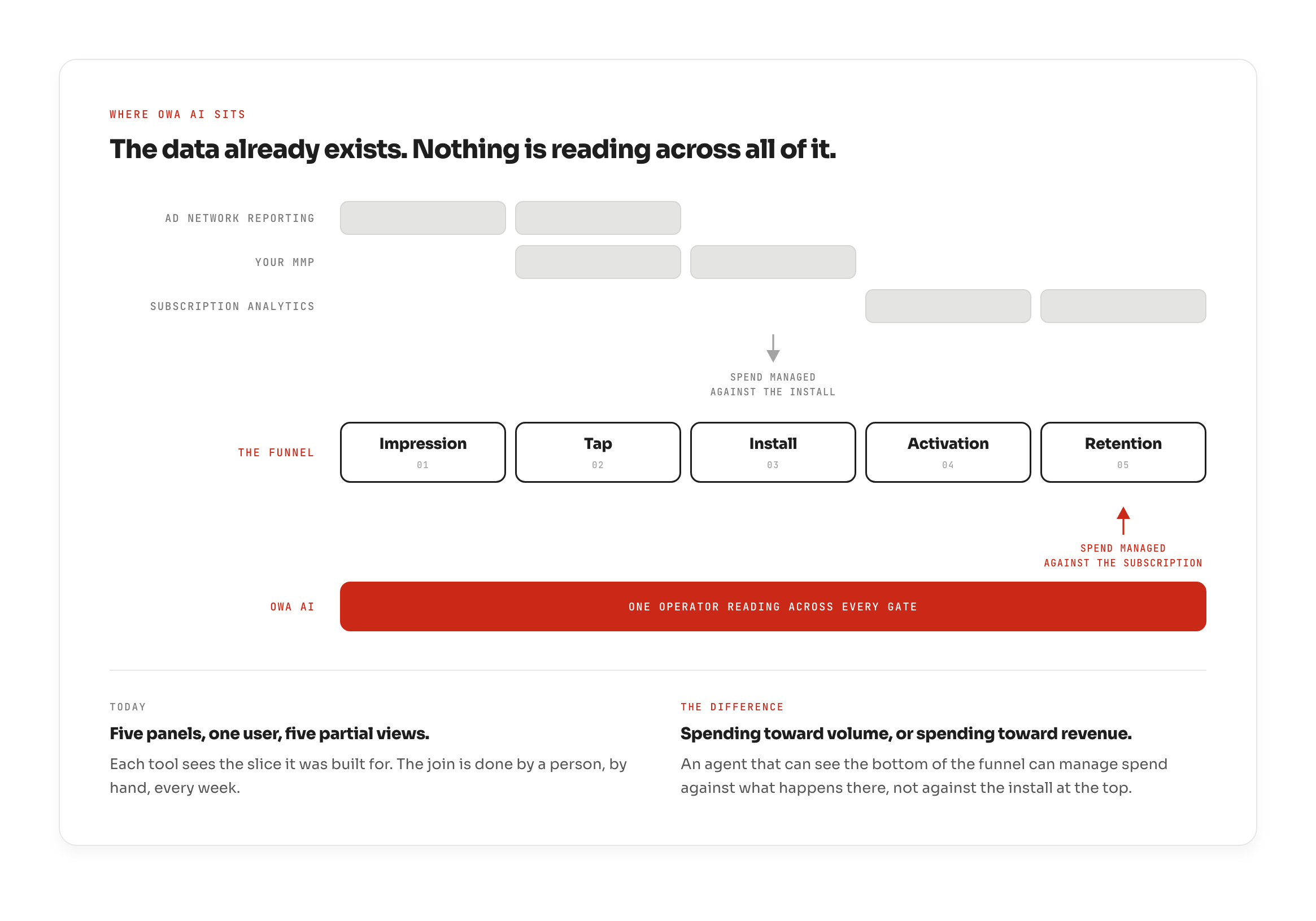
OWA already integrates AppsFlyer and Adjust, and the argument is the funnel itself: Impression, Tap, Install, Activation, Retention. An agent operating across every gate can manage spend against what happens at the bottom of the funnel, the subscription, rather than against the install at the top.
That is the difference between spending toward volume and spending toward revenue.
FAQ
What is an attribution model?
An attribution model is the rule that decides which touchpoint gets credit for a conversion when a user saw more than one ad. Last-touch credits the final click before install, first-touch credits the first interaction, and multi-touch distributes credit across several. The model matters because it changes which channel looks profitable. Two teams looking at identical raw data through different attribution models will reach different conclusions about where to spend next.
What is an attribution window?
An attribution window is the length of time after an ad interaction during which a resulting install or purchase still gets credited to that ad. A 7-day click window credits any install within a week of the click. Windows differ by network, which is a core reason two dashboards disagree: the same subscriber can fall inside two overlapping windows and be counted by both.
What is SKAdNetwork?
SKAdNetwork, usually shortened to SKAN, is Apple's privacy-preserving attribution framework, introduced alongside App Tracking Transparency in 2021. It reports install and conversion data to ad networks without exposing individual user identity, using delayed reports and a compressed conversion value between 0 and 63. It is the mechanism most iOS ad measurement now runs on, and it is widely expected to be succeeded by newer frameworks, though Apple has set no end date.
What does an MMP actually do?
For most iOS subscription apps running paid acquisition across more than one network, an MMP is how the conflicting numbers get consolidated and refereed in one place. It is a category, not a single choice. Which specific vendor fits which situation is its own question, and its own separate article. What matters here is the category's real job: it organizes and models the uncertainty Apple created. It does not remove it.
The Bottom Line
A founder who cannot say which dollar bought which subscriber is flying on the fuel gauge alone. The gap between your dashboards already exists. The only real question is whether anything is reading across it, or whether you are averaging two numbers and hoping.
There is also a more direct response to the whole dilemma this post describes, which is to stop running acquisition as an app campaign altogether and run it as a web campaign instead, escaping Apple's limits by never entering them. That is the subject of the third piece in this series.
First, see where your own numbers actually stand. Check your category against real CPI and retention data with the free Industry Benchmark & LTV Calculator.