Meta Ad Library and TikTok Creative Center: What Your Competitors' Ads Reveal About Their Growth
Meta Ad Library and TikTok Creative Center: What Your Competitors' Ads Reveal About Their Growth
A few years ago, when we were still an agency, we set out to build a creative strategy department. So we did what you do: we talked to the best creative strategists we could find, and we started hiring. The pattern in who was actually good surprised us. The strongest ones rarely came from marketing.
They came from engineering, journalism, and sales. An engineer thinks in tests and feedback loops. A journalist knows how to research a subject and turn it into a story. A salesperson knows how to handle an objection and what actually moves a person to act. Creative strategy is those three skills stacked: research a category systematically, break the problem down, read the feedback loop, understand the human on the other end. Marketing polish, it turned out, was the least important input.
Here's the part most app teams miss. The raw material for all that research is already public, already free, and updated every day by the people you're competing against. Most teams either never look at it, or glance at it and copy whatever looks most polished. That isn't research. It's converging on the category average, which is the opposite of a strategy. By the end of this piece you'll have a repeatable way to read your category's public creative map, and a prompt flow to run it yourself this week.
The best creative research resource is already public and free
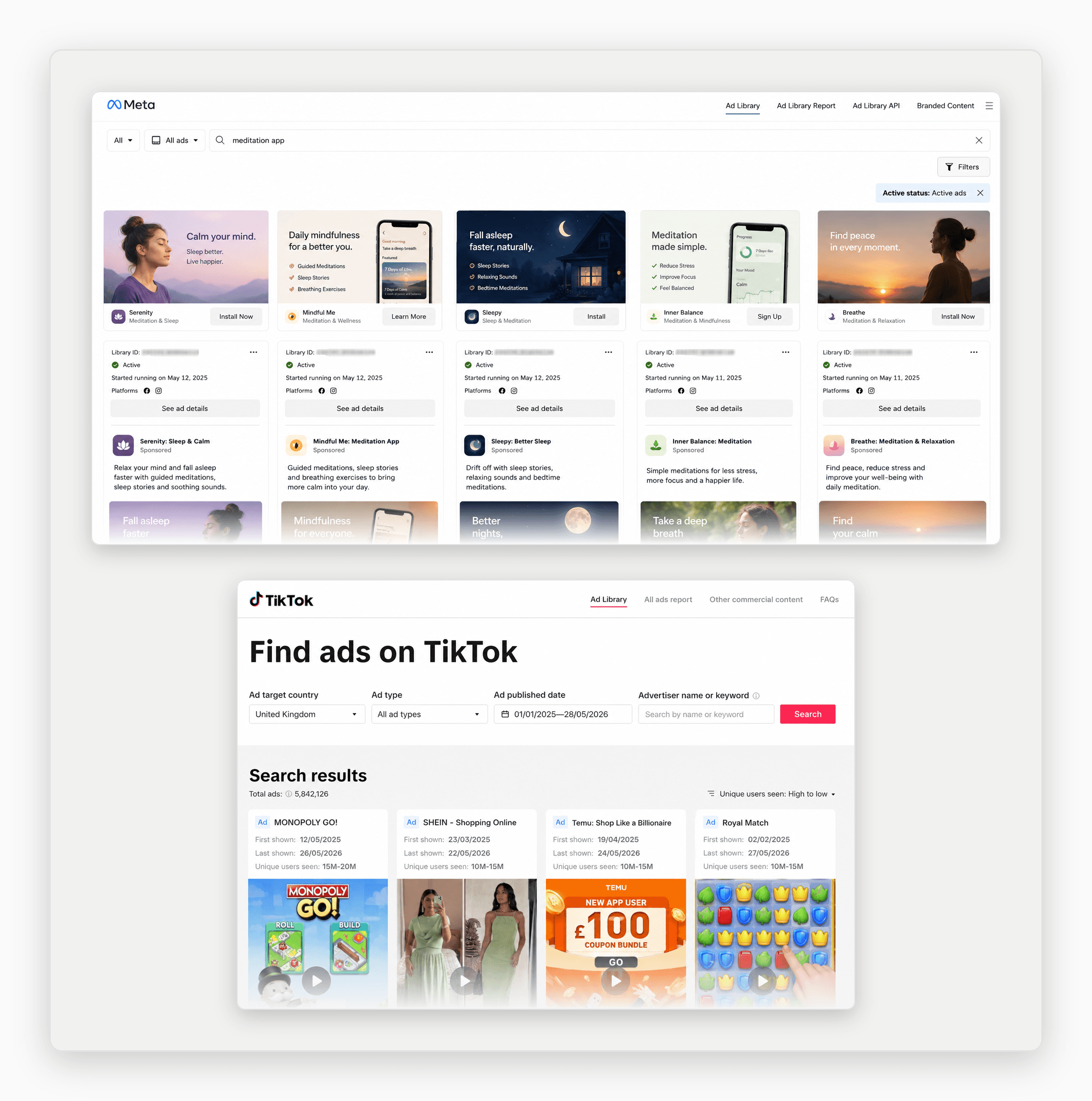
The Meta Ad Library is a searchable, public database of every ad running across Facebook and Instagram. Anyone can open it, look up any advertiser, and see every creative they're currently running, no login or spend required. The TikTok Creative Center is the equivalent read for TikTok: top-performing ads, trending formats, and what's live in your category right now.
Your competitors are in there. They're running creatives, targeting the exact audiences you want, and every ad they publish shows up in the library soon after it starts, usually within hours. They've left a map of their best guesses in public. This is not spying on ads in any shady sense; it's reading a leading indicator that most of your category ignores. The rest of this piece is how to read it.
How to actually pull the ads
The Meta Ad Library takes about two minutes to open for the first time.
1. Go to facebook.com/ads/library.
2. Set the country and category, then search the competitor's brand name.
3. Select their page from the results. You're now looking at every ad they have live.
4. Filter to active ads and switch to the platform view to separate Facebook from Instagram placements.
The Instagram ad library isn't a separate tool, it's the same Meta Ad Library filtered by platform. A browser extension can speed up repeat lookups, but you don't need an ad library Chrome extension to do the work; the native library is enough.
The TikTok Creative Center works the other way around. Instead of starting from one competitor, you start from the category: browse Top Ads, filter by industry and region, and sort by likes or reach to see which concepts are pulling in your space. The TikTok ads library rewards pattern-spotting across many advertisers more than deep single-brand digging. (For advertiser-level transparency the way Meta offers it, TikTok keeps a separate tool, its Commercial Content Library, focused on the EU.) Use Meta to study a rival end to end, and TikTok to read the category's mood.
How to read the signals
Pulling the ads is the easy part. Reading them is where the strategist's eye earns its keep, and it starts with one number: how long each ad has been running.
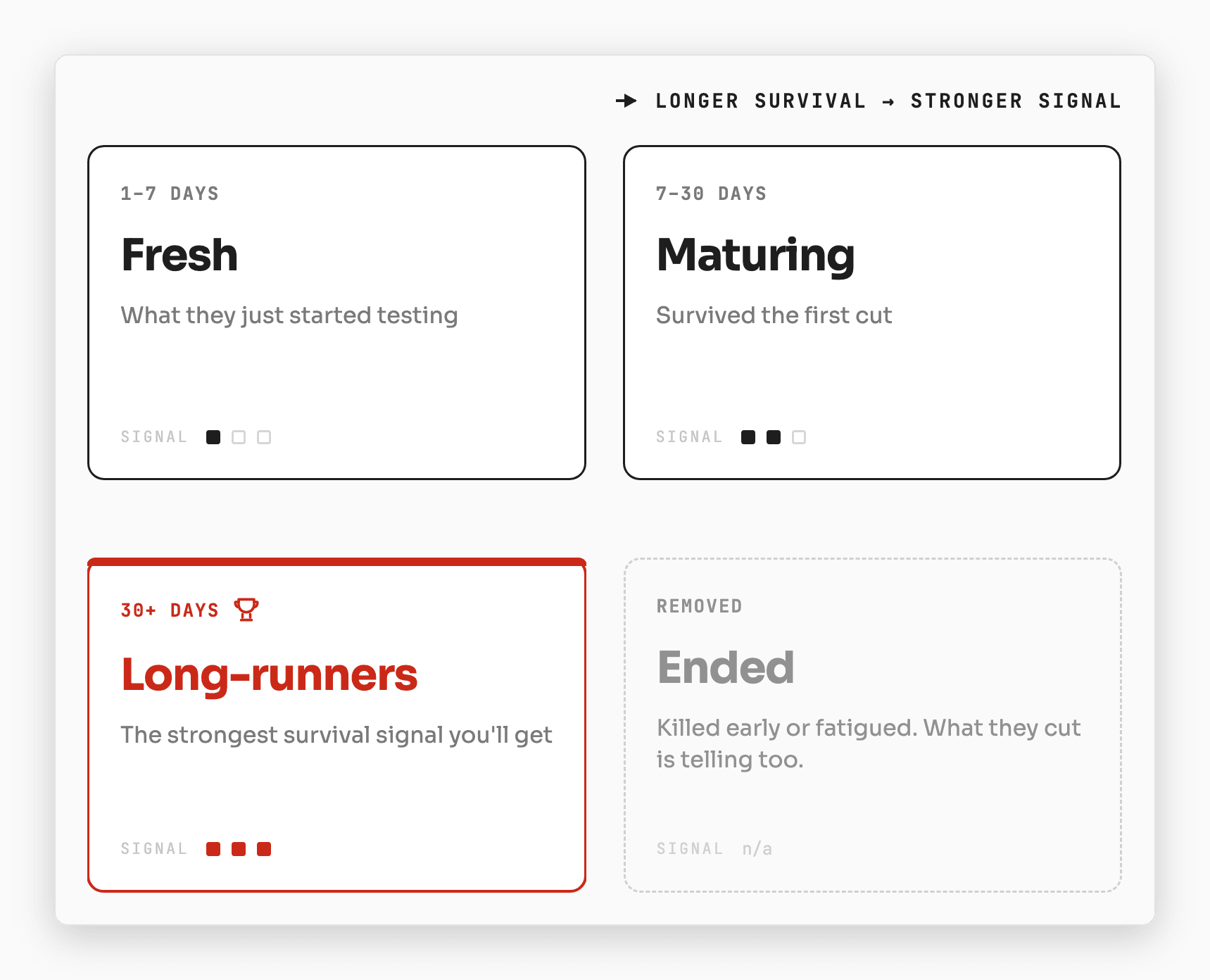
Think of every ad in one of four life stages.
Fresh (1 to 7 days) is what they just started testing.
Maturing (roughly 7 to 30 days) has survived the first cut.
Long-runners (30, 40, 60-plus days and still live) are the strongest signal you'll get.
And ended ads that ran under a week were killed early, eliminated tests, not automatically bad ideas.
One caution matters more than any other here. A long run time is a survival signal, not proof of performance. An ad that's been live for two months might be a genuine winner, or it might be a neglected always-on campaign with a tiny budget nobody has turned off. You will never see conversion data in a public library, so never tell yourself "this one converts." You're reading survival, not results.
Variation count is the second language. One creative is a pilot. Two or three is active testing. Four or more variations of the same concept means real budget is behind it, they're scaling. Read the spread, too: many different concepts running at once signals a strong creative engine. One concept stretched across a dozen variations can mean they're out of fresh ideas, which is an opening for you to attack with a new angle.
Two more shifts change how you read everything.
First, the creative is the targeting now. The algorithm decides who sees the ad; your real lever is the concept, the hook and angle and persona, not the format. Second, polish can be a trap. If every ad in a category is studio-grade, a raw, native-feeling ad is often the opening, which is exactly how indies out-convert bigger spenders on angle instead of budget. Fatigue, meanwhile, is now measured in weeks, not months.
The map tells you where to point your tests. It never hands you a winner.
Anatomy of a top-spending ad
To show what this looks like up close, here's how one of our clients' highest-spending ads was actually built, beat by beat:
1. Fear hook: opens on the thing the viewer is afraid of, so they stop scrolling.
2. Open loop: a big promise held just out of reach, so they have to keep watching to see it pay off.
3. Authority intro: establishes who's talking and why they'd know.
4. Failed alternatives: the fixes the viewer has already tried, and why each one let them down.
5. Hidden root cause: the real reason none of those worked, which nobody named before.
6. Problem mechanism: how that root cause actually creates the problem.
7. Cost of inaction: what it keeps costing them to leave it unsolved.
8. Product intro: only now does the product enter, as the answer to the root cause.
9. Solution mechanism: how the product fixes what the alternatives couldn't.
10. Transformation, short-term: what changes right away.
11. Transformation, long-term: where they end up down the line.
12. Social proof: other people who got there.
13. Price anchor: the value framed against a higher reference point.
14. Risk reversal: a guarantee that takes the downside out of trying.
15. Scarcity: a real reason to act now, not later.
16. Call to action: one clear next step.
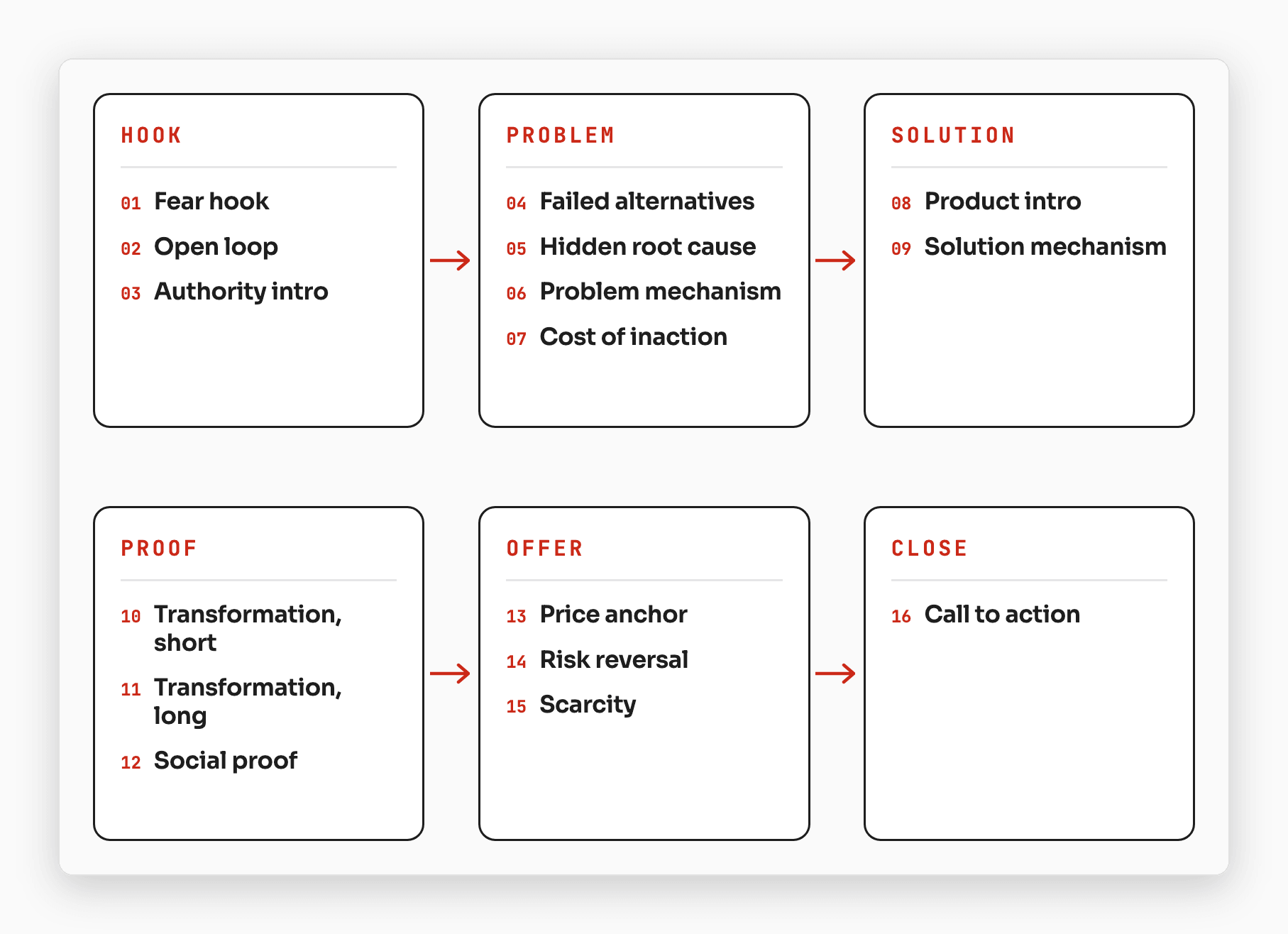
In the trade, that shape is an authority-led video sales letter.
The point isn't to copy that structure. It's that every winning ad has a structure, and each account, each creative, carries its own. Learning to see the anatomy, to watch an ad and name its moving parts, is the skill. Once you can do it for one ad, the problem becomes doing it at scale.
From one anatomy to patterns
Here's the wall you hit. A single client's competitors can run hundreds of creatives in a week. Nobody can watch that many videos, hold each anatomy in their head, and still spot the pattern across all of them. The human eye runs out long before the ads do.
So you simplify, deliberately. You step down from full ad structure to concept and creative pattern, then down again to the hook alone. At each level you sort for two things: the most-used hooks and bodies, which are proven but usually saturated, and the rarely-used, newly-tested ones, which are where the fresh inspiration hides. Do that consistently for a year and you've built something no competitor can buy: a real read on what your audience has already been influenced by, and which of those ideas survived long enough to look like they worked.
That's the manual discipline. It's also where it stops being feasible by hand.
How we collapse the manual work
Reviewing hundreds of creatives one by one isn't realistic on a founder's schedule, and even if you push through, holding the pattern in your head is the harder problem. This is where our research layer comes in, and it mirrors the exact discipline above.
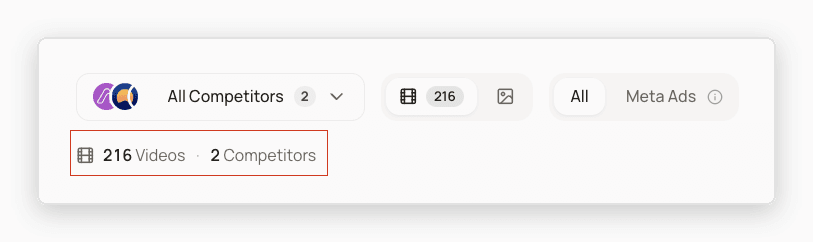
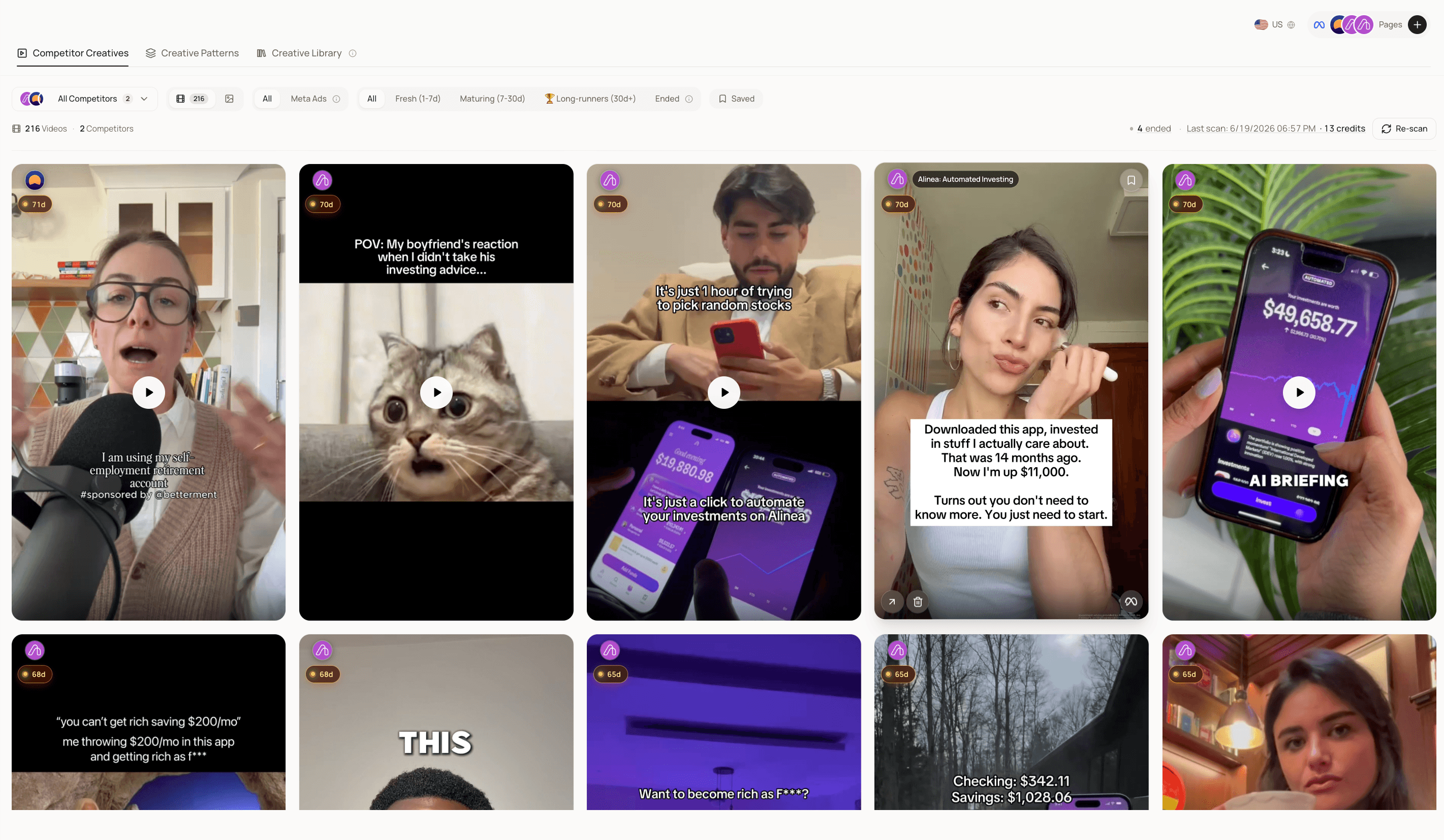
Competitor Creatives pulls every competitor's active and past ads into one feed, auto-sorted into the four life stages, Fresh, Maturing, Long-runners, Ended, with a days-live badge on each. The read you'd do by squinting at run dates is just there.
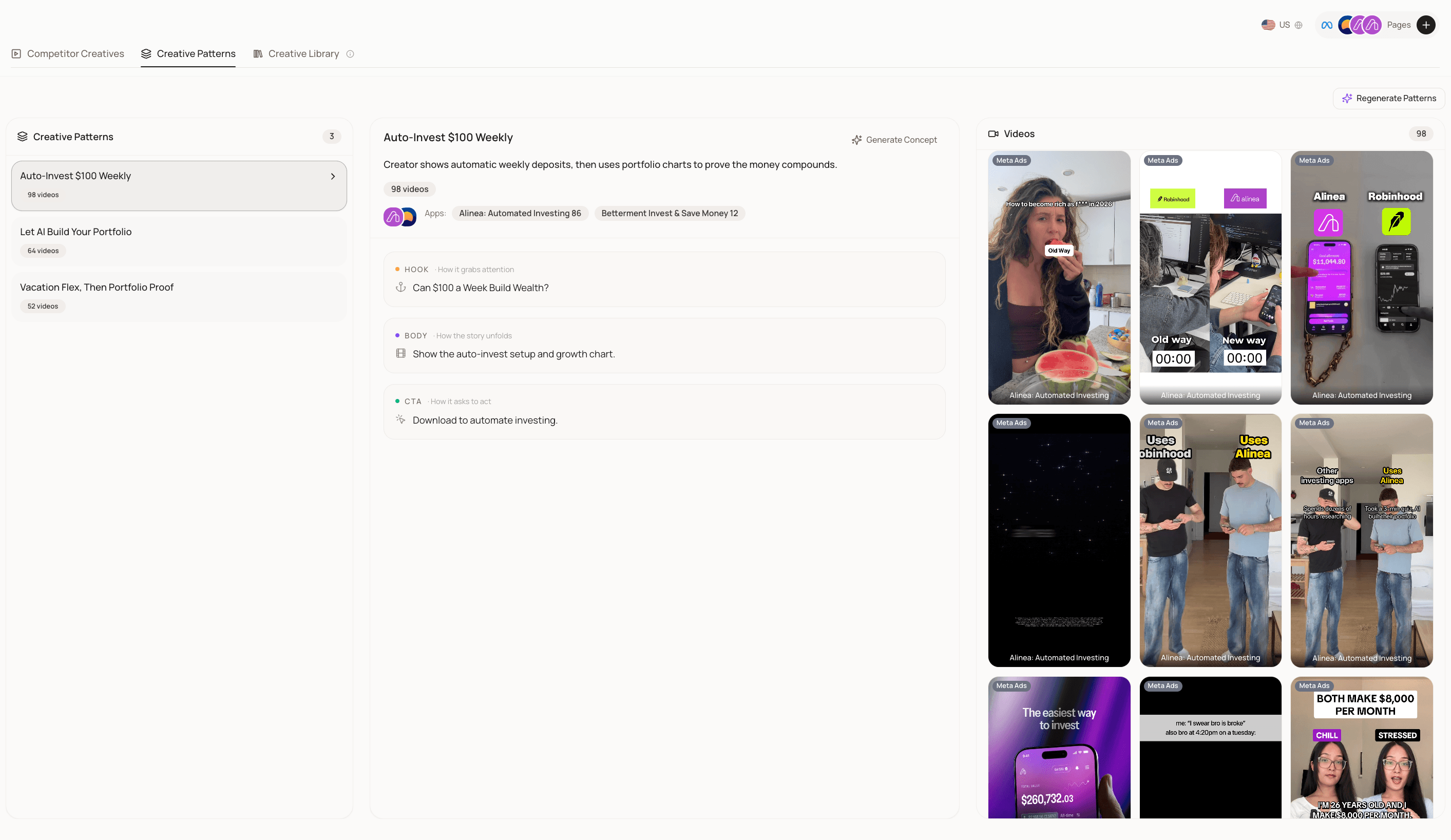
Creative Patterns analyzes every video and surfaces the recurring ones, each opening into its Hook, Body, and CTA. This is the hundreds-to-pattern collapse, done automatically, so you're looking at the shape of the category instead of scrubbing through it clip by clip.
Creative Library is a cross-app board you can browse and filter by Creative DNA, platform, and category, the inspiration bank without the year of manual logging.
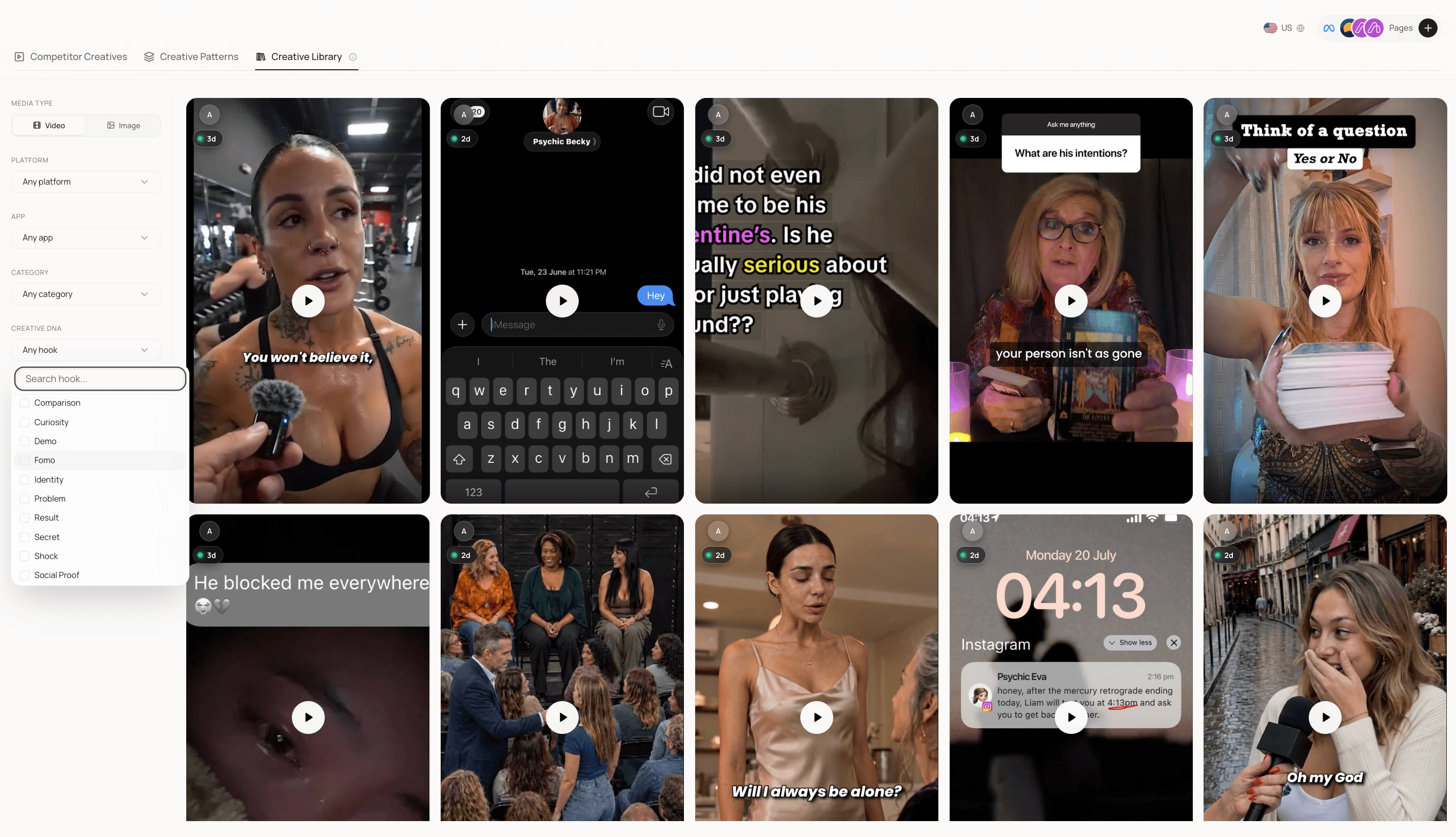
We're extending this too: automatic scanning on a cadence so category changes arrive as insights without you asking, a TikTok library inside the same view, and further out, a production layer that turns a chosen concept into finished creative. Those are in progress; the four-stage read and pattern breakdown are live today.
You can hand the read to a model
The pattern-finding itself can be handed to a model. You don't watch 800 videos; you pull a sample, feed it in, and run the audit the way a strategist would. The honest catch: the model can't watch the videos or open the library for you, it works on what you paste, so your inputs set the ceiling. Collect well and a wall of ads becomes a briefing.
What to collect. 15 to 40 competitor ads from the Meta Ad Library and TikTok Creative Center. For each, note its run-time (days live), how many variations exist, the opening line or on-screen text, and the platform. Then run the steps below, one at a time.
Setup (paste first):
"You are a senior creative strategist auditing competitor ads I collected from public ad libraries. Follow three rules throughout. (1) Observe before you interpret: when you tag an ad, describe what is IN it, never why it 'works,' and never use judgment words like effective, engaging, creative, or successful. (2) Match your confidence to the data: you did not watch these videos, you work from the transcripts, on-screen text, run-times and variation counts I paste; if I give you fewer than about 12 ads, treat every finding as qualitative, not statistical. (3) Never invent an ad, a number, or a competitor; frame every finding as 'X of the N ads I gave you,' never 'the market.' Wait for my ads before you begin."
Step 1 - Tag each ad (observe, don't judge):
"For each ad return: a one-line summary of what literally happens; the hook type (pick ONE: problem, before/after, curiosity, FOMO, identity, shock, demo, result, education, social proof, story, secret, trend, comparison) and the exact opening line; the visual hook (what fills the first frame); how the body unfolds; the ENDING emotion (what the viewer feels when it ends, not at the open); the CTA; the moment the brand first appears; and production notes (on-screen-text density, sound type, face on screen y/n, pacing). If the hook type is ambiguous, pick the one that matches the viewer's first reaction in the opening 1-2 seconds, the first signal that fires wins."
Step 2 - Find the patterns and grade them:
"Surface the recurring patterns across the set. A tag in more than half the ads is noise, drop it; a real pattern lives in roughly 3 to 40 percent of the set. Define each pattern with 2 to 4 tags from at least two categories (for example a hook type plus an ending emotion) and name it so it tells me what to DO ('curiosity-hook UGC confession,' not 'emotional videos'). Grade each pattern by how many ads carry it (5+ = strong, 3-4 = medium, fewer = weak) and flag any running across 2 or more competitors as a shared category pattern."
Step 3 - Read the signals honestly:
"Interpret carefully. Long run-time and variation count are SURVIVAL signals, not proof of performance, so never say an ad 'converts.' Apply these reads: 30+ days still live = likely a winning formula; under 7 days and gone = an early-killed test; stopped within the last two weeks = genuinely uncertain, say so. Variation count: 1 = pilot, 2-3 = testing, 4+ = scaling real budget; many different concepts at once = a strong creative engine, one concept stretched thin across many variations = possibly out of ideas and open to attack. Two honesty checks: when a pattern is everywhere, give me both readings (proven vs saturated-to-death) and weight it by how many distinct competitors it comes from (a pattern from 3 advertisers is not the same as one from 10); and treat fatigue as an inference from what changed over time, not a number, the only certainty is that fatigue now cycles in weeks, not months."
Step 4 - Pressure-test against how the platform
"For the patterns that survived, score them against Meta's physics and tell me where each is strong or exposed. The hook has a 3 to 5 second window and needs a re-catch around second three. Most people watch with sound off, so run the mute test: muted, would the message still land through the on-screen text? Voiceover plus dense captions is the workhorse format, and a human face raises trust. The default narrative anatomy is Hook, Problem, Scratch, Solution, Proof, CTA (the Scratch beat can drop for a product that creates a new desire). Duration norms: 6-15s for awareness, 15-30s for a UGC demo, 30-45s for an advertorial story. Note which patterns lean on current AI-era hooks: a POV open, a deliberately unpolished 'not-an-ad' look, a list open ('3 things I wish I knew'), or a pattern-break frame that couldn't exist without AI."
Step 5 - Turn it into concepts to test:
"Give me four concepts, safest to riskiest, and name each one's persona and awareness stage FIRST (a concept with no persona is a guess, reject and rewrite it). 1) Pattern Match: adapt a proven category pattern to my product. 2) Counter-position: bet against what everyone does, take the empty lane. 3) Persona Shift: same product, a different user type or awareness stage. 4) Format Break: break the category's visual or format norm. Assume I win on angle, not budget. For the visual direction, the words clean, modern, professional and eye-catching are banned, they say nothing; describe a concrete look instead, like '0.5x selfie corridor POV' or 'messy-desk founder confession.' If any of my own ads are fatiguing, tell me whether to iterate (new opening frame, same concept) or diversify (new hook + angle + persona), and remember near-identical variations get penalized in the auction."
Step 6 - Generate hooks as a matrix:
"For the concept I pick, pull 2 to 3 real hook lines from the competitor ads first, then write new hooks as a matrix, not a list: psychological angle (pain / desire / belonging / curiosity / identity / contrarian) times hook type (pattern-break / question / result-reveal / contrarian claim / curiosity gap / problem call-out) times awareness stage. Each new hook should either match the rhythm of what's surviving or break it on purpose. Keep the body and CTA fixed so the test measures the hook alone."
Run that loop and the public library stops being a wall of videos and becomes a briefing. Our research layer runs this same discipline automatically, at category scale, but you can start the manual version this week.
FAQ
What is the Meta Ad Library?
The Meta Ad Library is a free, public database of every ad currently running across Facebook and Instagram. You can search any advertiser and view all of their active creatives without an account or any spend. It's designed for ad transparency, which also makes it the single best free competitor-research resource for app teams.
Is the TikTok Creative Center free?
Yes. The TikTok Creative Center is free and open to anyone. It surfaces top-performing and trending ads by industry and region, so you can read which concepts are working in your category without running a single campaign yourself.
Can you see a competitor's ad spend or performance in the ad library?
No. Public libraries show which creatives are running and how long they've been live, but never spend, conversions, or ROAS. A long run time is a survival signal, meaning the ad wasn't turned off, not proof that it converts. Treat it as a leading indicator, then test your own version to learn what actually performs.
How long does a winning ad usually run?
There's no fixed number, but ads still live at 30, 40, or 60-plus days are your strongest survival signal. Anything under seven days that disappears was likely an early-killed test. Just remember survival isn't the same as proven performance.
Is there an ad library Chrome extension?
Several browser extensions exist to speed up repeat lookups and organize saved ads, but you don't need one. The native Meta Ad Library and TikTok Creative Center give you the full public picture on their own.
The read most teams skip
A competitor's public library is a leading indicator, and the teams winning in saturated categories treat it as one. They watch what's fresh, what's surviving, and what nobody has tried yet, then point their own tests accordingly. Most app teams never open the tab.
Read it honestly and it won't hand you a winner, real winners are rare and spend stays concentrated. What it hands you is a shorter list of angles with a real shot.
That's the whole game: fewer guesses, better aimed. You don't have to keep guessing blind.
If you'd rather not run the read by hand, let OWA map your category's creatives automatically.
Start trial and see it in your own category, or book a call and we'll walk your competitive map with you.